
What is Meenakari?
Sunita Shekhawat · 16 June 2026
The Modern Meenakar · Founder, Museum of Meenakari Heritage
Updated 9 September 2026
Meenakari is the Indian art of enamelling, in which powdered mineral glass is settled into engraved cells on a gold surface and fired in a kiln. Practised in Jaipur on twenty-two-karat gold since the late sixteenth century, meenakari produces a coloured jewel surface that holds its hue for generations.
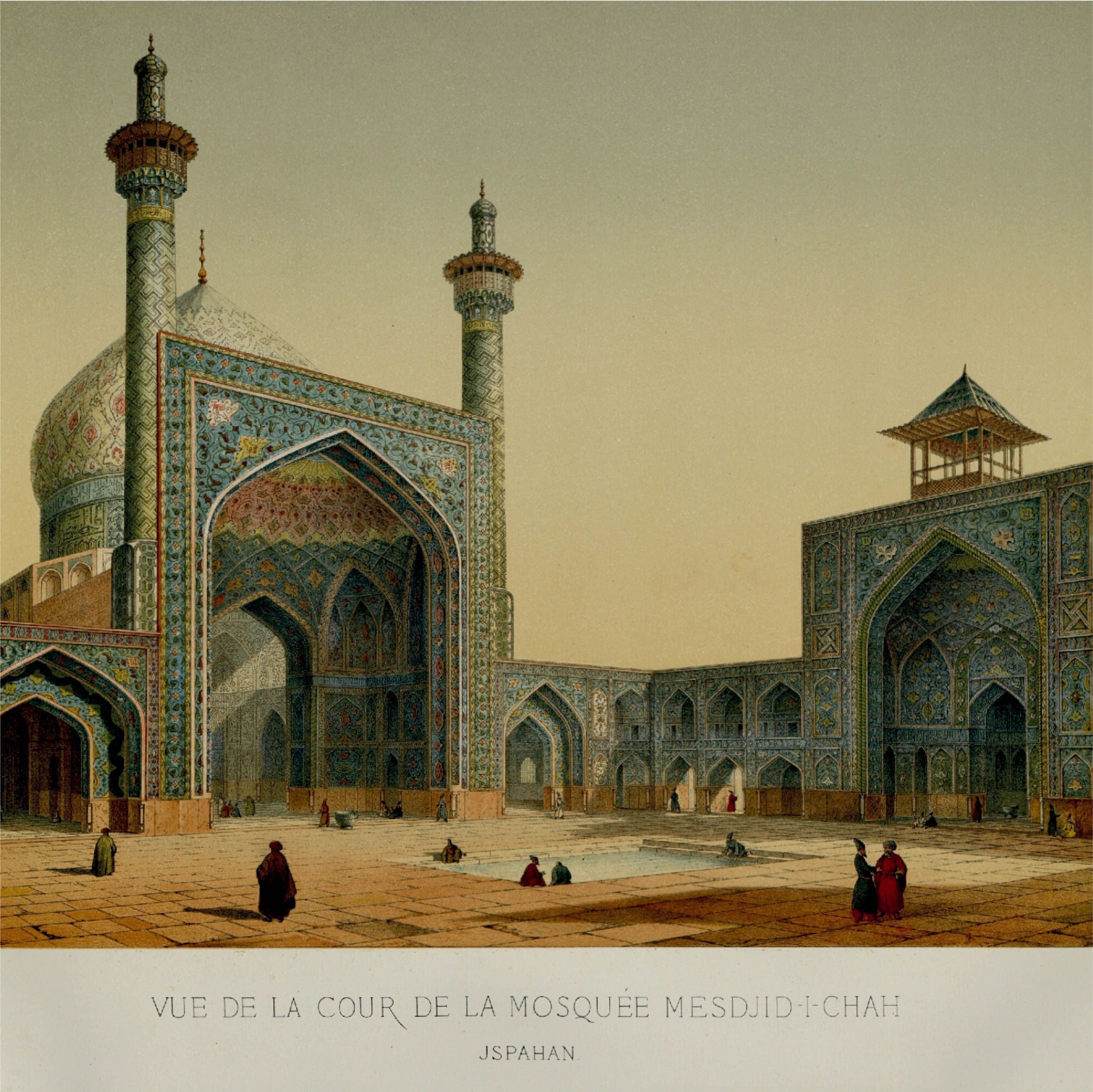
Etymology
The word is Persian. Meena is enamel, and before that, the azure sky. Kari is the act of placing. To make meenakari is to place the sky onto gold. A goldsmith first engraves the surface of the jewel into fine cavities, each no wider than a fingernail. A meenakar then settles powdered mineral glass into those cavities, with colours drawn from cobalt for blue, iron oxide for red, copper compounds for green, antimony for white, and the rare pink that asks for selenium and gold-chloride and the steadiest hand at the kiln. The jewel enters the kiln as one thing and leaves as another. What the karigar lifts from the heat is no longer gold nor glass, but a third material that will hold its colour for centuries.
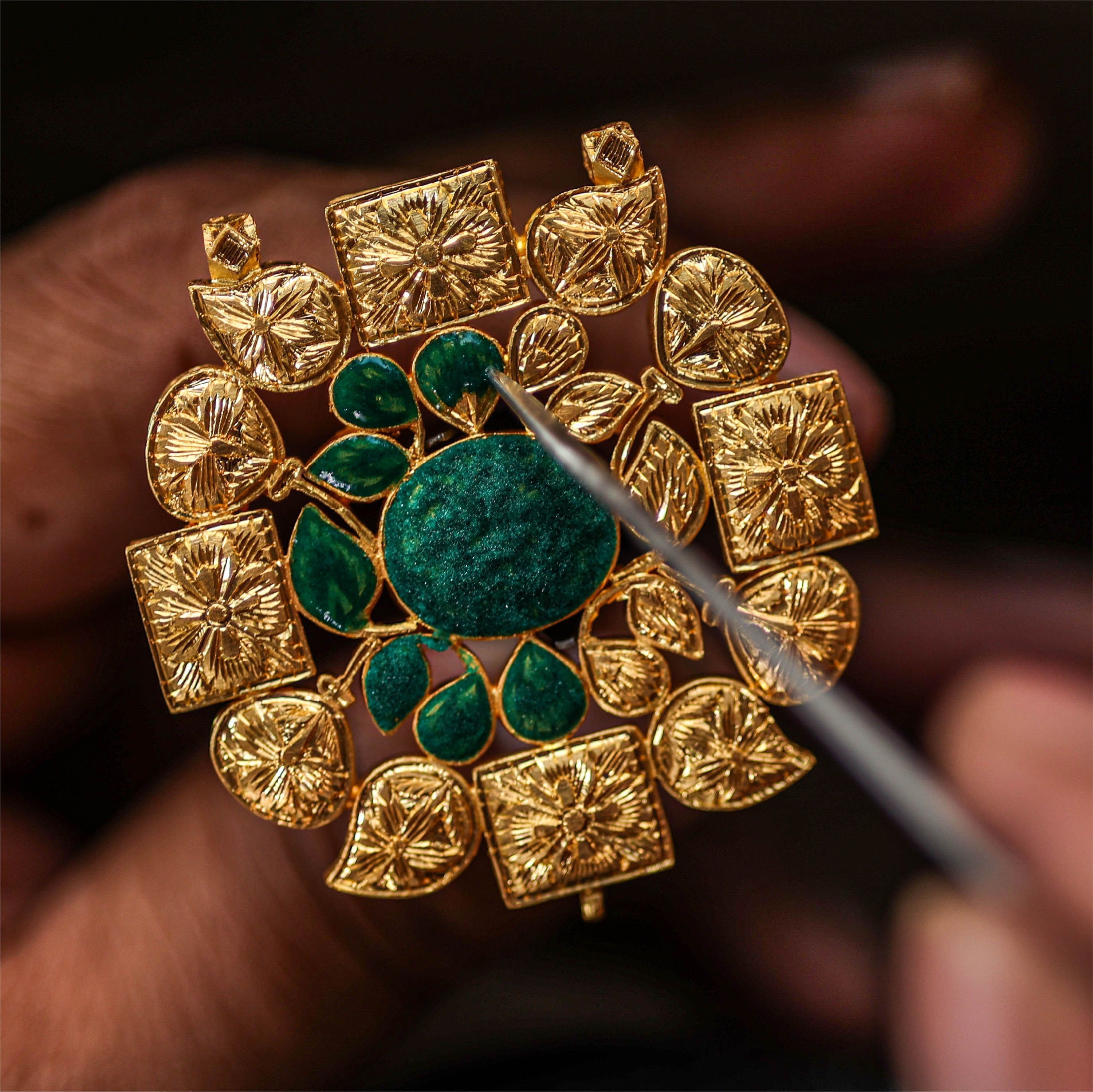
The base of a meenakari jewel at The House of Sunita Shekhawat is twenty-two-karat gold. The thin slice of gold around the uncut polki, called the kundan, is twenty-four karat. The enamel is laid into the engraved cells of the twenty-two-karat surface. Each colour is fired at its own temperature, between seven hundred and fifty and eight hundred and fifty degrees Celsius. A piece in seven colours asks for seven firings. A bridal piece can take months.
This is the craft Jaipur is celebrated for. It is also the craft this atelier was built to carry forward.
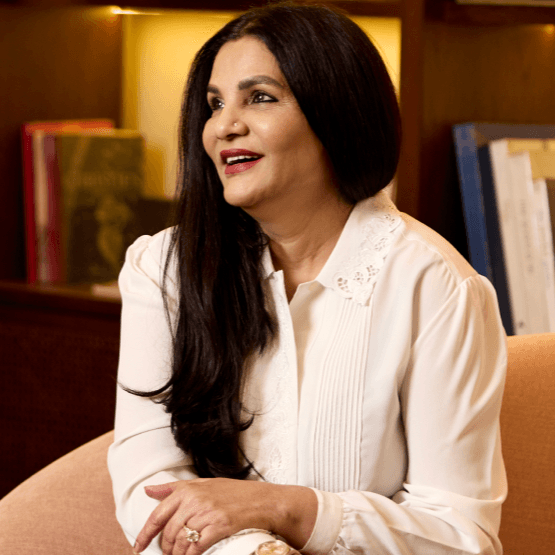
“The reverse of a polki jewel was never meant to be seen. In this house, we have made it the face.”
Sunita Shekhawat,
Founder
How Enamel Came to Jaipur
Enamel is among the oldest decorative arts of Europe. In Limoges, in the French Massif Central, it has been practised since at least the twelfth century. From Limoges it travelled by trade, first to Lisbon, where Portuguese merchants carried it onto the sea routes to Asia. By the early sixteenth century, Portuguese ships were carrying enamel, its raw glass, its mineral palette, and its method, to the western coast of India. They held Goa from 1510 onward. There, European enamelling first found soil in Indian workshops. The craft moved inland slowly, absorbed by local goldsmiths, and over a generation it was redrawn in Indian colour.
The Mughal court did not arrive in India without enamel. Babur, the Timurid prince who founded the dynasty in 1526, came from Ferghana in Central Asia, where his ancestors had ruled at Samarkand and Herat. The Persian decorative traditions of those courts had been acquainted with enamel for centuries through Silk Road trade with China and Byzantium. Persian mina, the word from which meenakari takes its name, was practised on metal in the Sassanid courts long before the Mughal age.
In India, the Mughal court added to this inheritance through direct trade with European merchants for raw glass, for pigment, for refinements of pattern. The finest glass came from Murano, the same furnaces that had given Venice its mirrors. The Mughal style that followed was not a borrowing. It was an amalgamation: Persian foundations, European materials, Indian colour. The period detail of this trade is preserved in the curatorial research of Dr Usha Balakrishnan for the Museum of Meenakari Heritage, drawing on sources including Sir Thomas Roe's Embassy, the seventeenth-century journal of the English ambassador to the court of Jahangir.
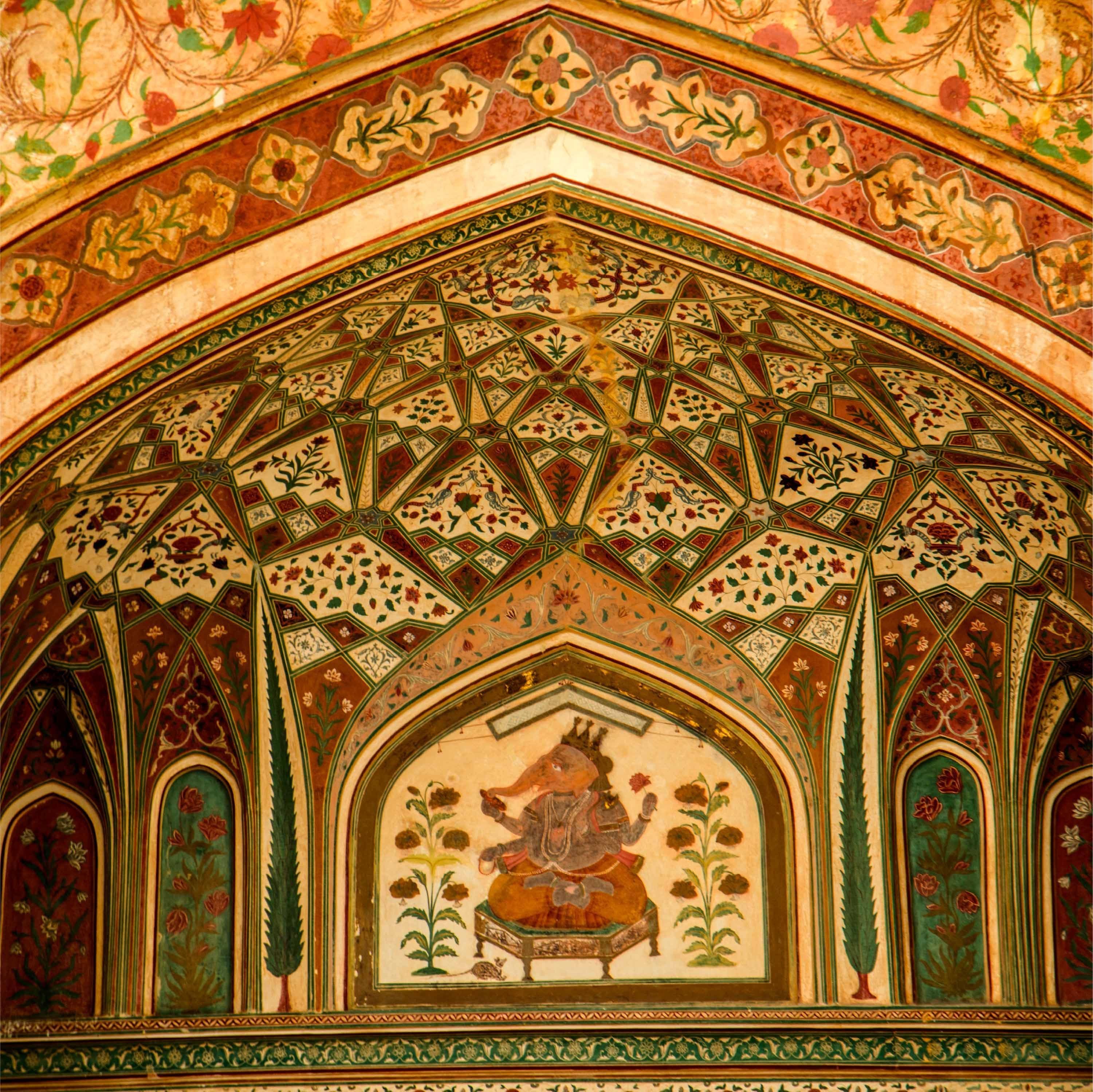
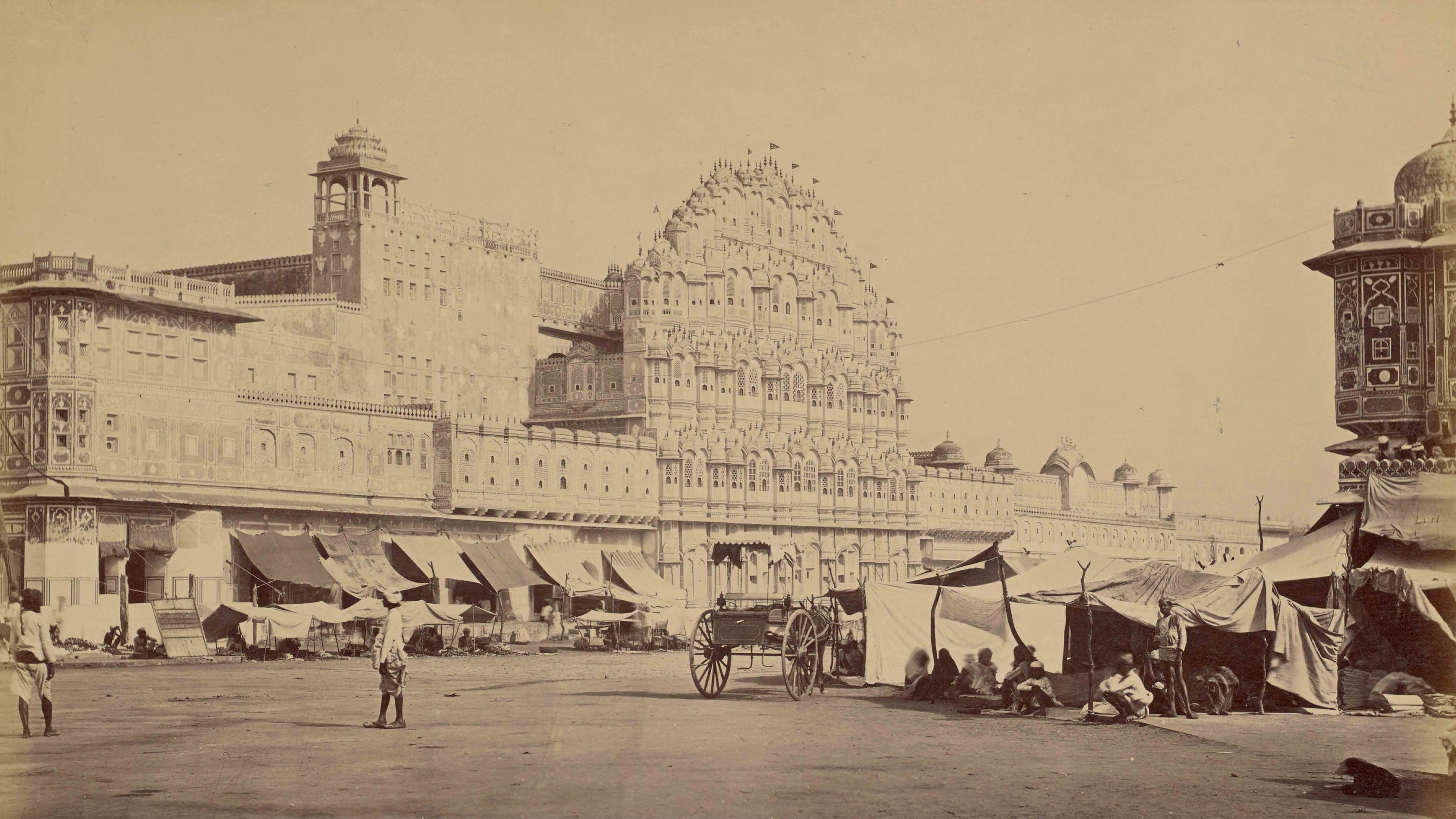
The Jaipur tradition descends from the Mughal court, not from the Portuguese coast. In the late sixteenth century, under Mughal-era patronage, enamel artisans from Lahore were drawn into the workshops at Amer. Their craft moved south to the new city of Jaipur, planned by Sawai Jai Singh II in 1727 as a centre for the arts and sciences. Thomas Holbein Hendley, the English surgeon who lived and wrote in Jaipur through the 1880s, called it the foremost centre of enamel in all of India.
Not much has changed since. The apprentice still sits across from the master. The kiln still speaks in small breaths of heat. The colour still arrives one firing at a time. Today, this is the heritage the atelier draws on, piece by piece.

A History in Colour
What each demands of the hand.
The Five Colours
of Jaipur
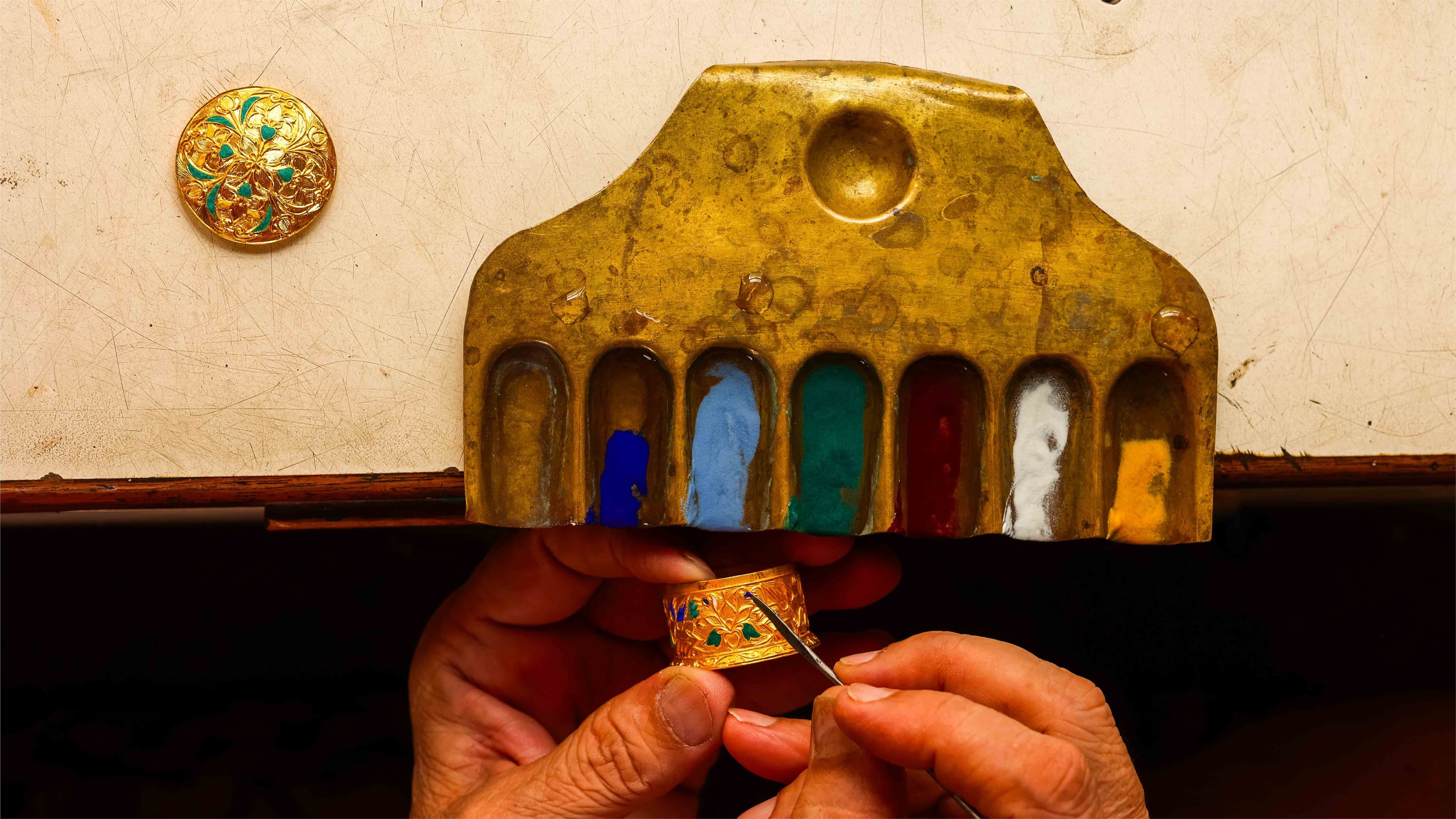
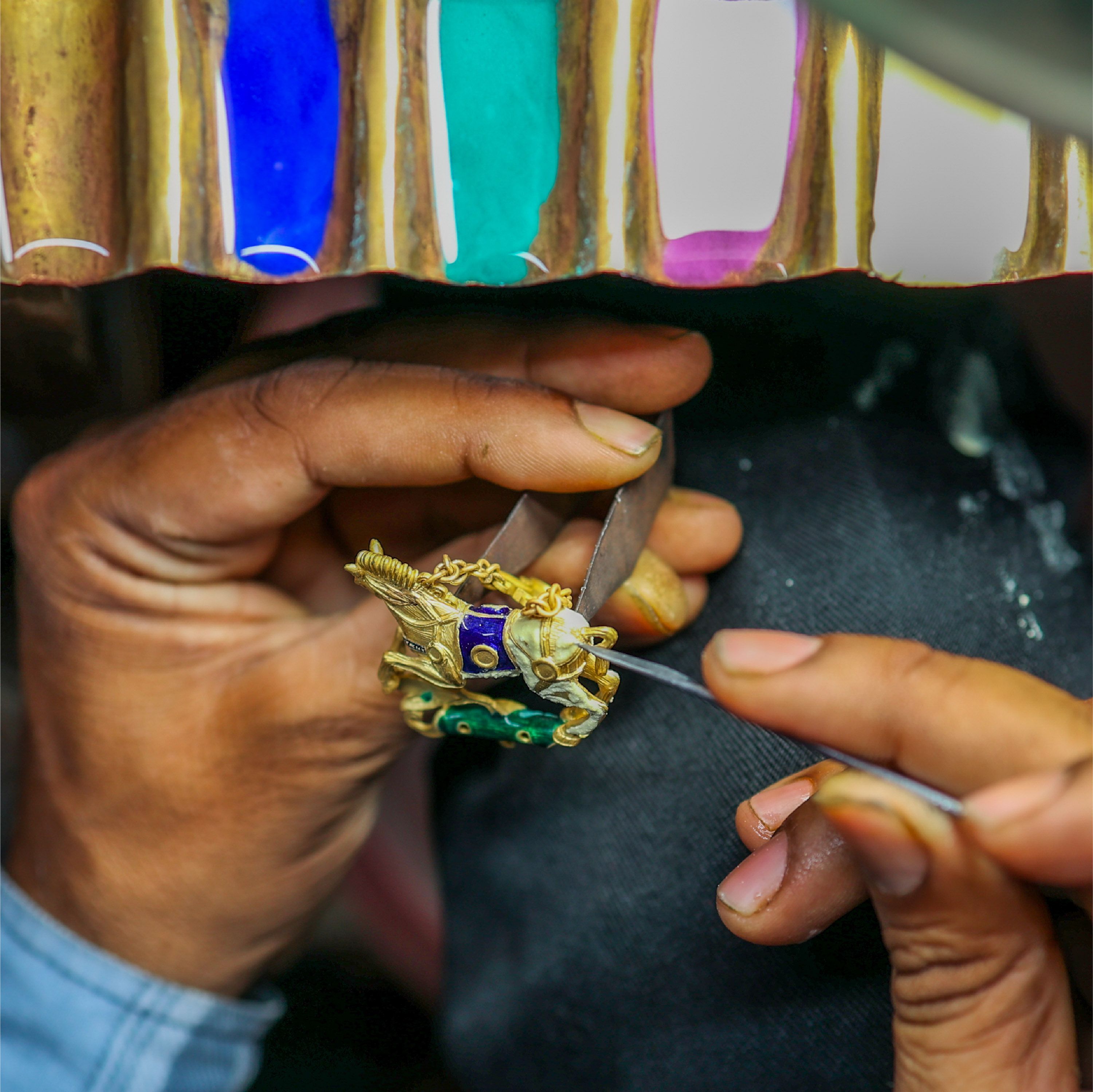
Each colour is the fingerprint of a different mineral. Cobalt for the blue. Iron oxide for the red. Copper compounds for the green. Antimony for the white. Selenium with gold-chloride for saffron's warm tones. Each enters the kiln at its own temperature, between seven hundred and fifty and eight hundred and fifty degrees Celsius. A piece carrying all five is fired five times. The five together are the most recognisable expression of Jaipur enamel, found across the great archive of nineteenth-century pieces that travelled from the treasuries of the maharajas to museum collections in Europe and North America. This is the palette the world has come to know as the Jaipur tradition.
Panchrangi
“The Five Colours”
Jaipur meenakari is built on five colours. The five together are Panchrangi, from panch, meaning five. They are the colours of the great gemstones the city's jewellers have always set in gold: ruby for the red, emerald for the green, sapphire for the blue, diamond for the white. The fifth is saffron, the warm colour found in marigold, in turmeric, in the robes of ascetics, in a setting sun.
Gulabi
“The Pink”
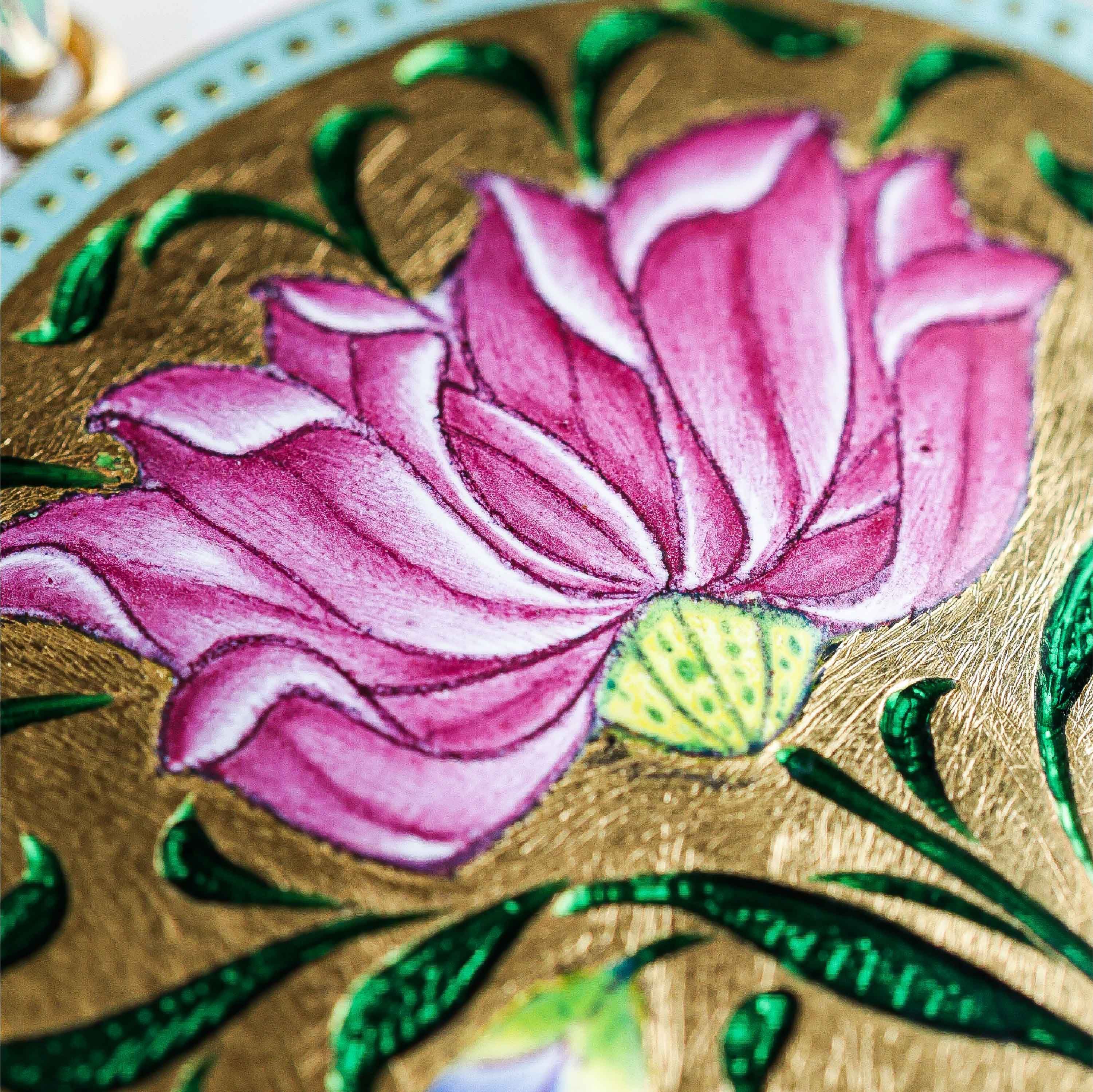
Beside the five-colour Jaipur palette sits a kindred tradition with older roots. Gulabi, the pink, was born in Varanasi, the ancient centre of Banaras, where it is recognised today as a Geographical Indication. It carries the soul of that craft: a base of white enamel, pink strokes laid with intention, lifted by green and blue accents in floral and lotus motifs. It is a language of colour that has travelled far and grown richer with time. Today, we speak it best. In Jaipur, no one does pink like we do.
The same five colours are also those of the Panchranga, the five-stripe banner of the Jaipur royal house. The flag is said to have been brought back by Raja Man Singh I after his late-sixteenth-century campaigns against the Afghan tribes, where, by tradition, he carried home the captured banners of five defeated chiefs. Whether the meenakars borrowed from the flag, the flag from the meenakars, or both from a deeper shared cultural memory, the city's most recognisable craft and its most recognisable banner share their five colours by an arrangement too neat for accident.

How It Is Made
At The House of Sunita Shekhawat, a piece of fine jewellery is made through four crafts in concert: framework, gem setting, engraving, and the enamel itself. A single jewel passes through the hands of seven or eight specialist karigars, each of whom has done only his own stage for most of his life. Meenakari is the last of the four, and the most delicate. The work is slow. A small pendant in three colours asks for three firings and several weeks at the bench. A multi-colour bridal piece can take months. The full process can be read as six stages. The first three prepare the body of the jewel. The next two place the colour. The last polishes the work into its finished state.
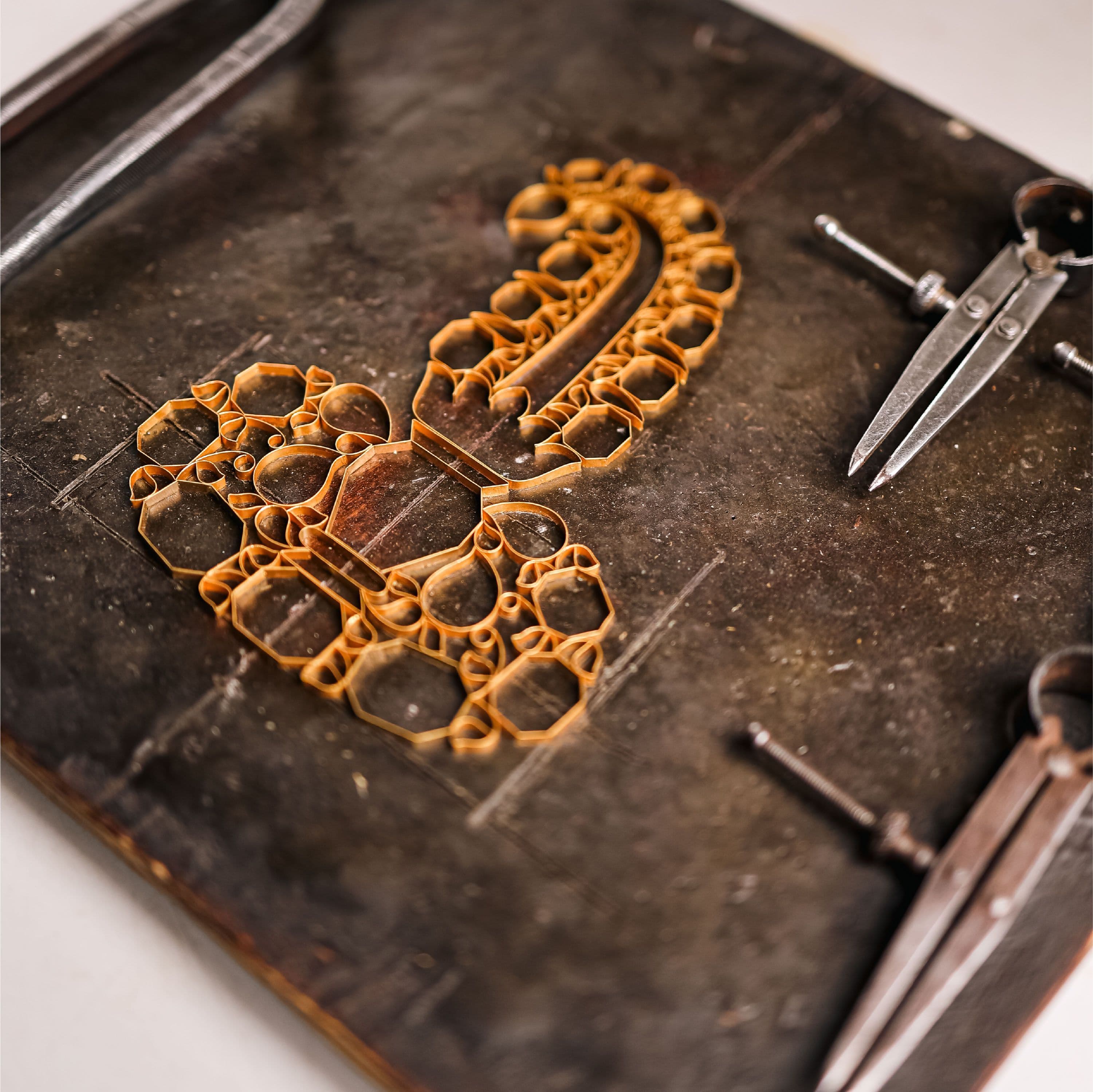
Framework
The structure of the jewel, the body of a necklace, the band of a ring, the spine of an earring, is made first. The base is twenty-two-karat gold, shaped to hold both the engraved surface that meenakari will sit on and the cells that will hold uncut diamonds.
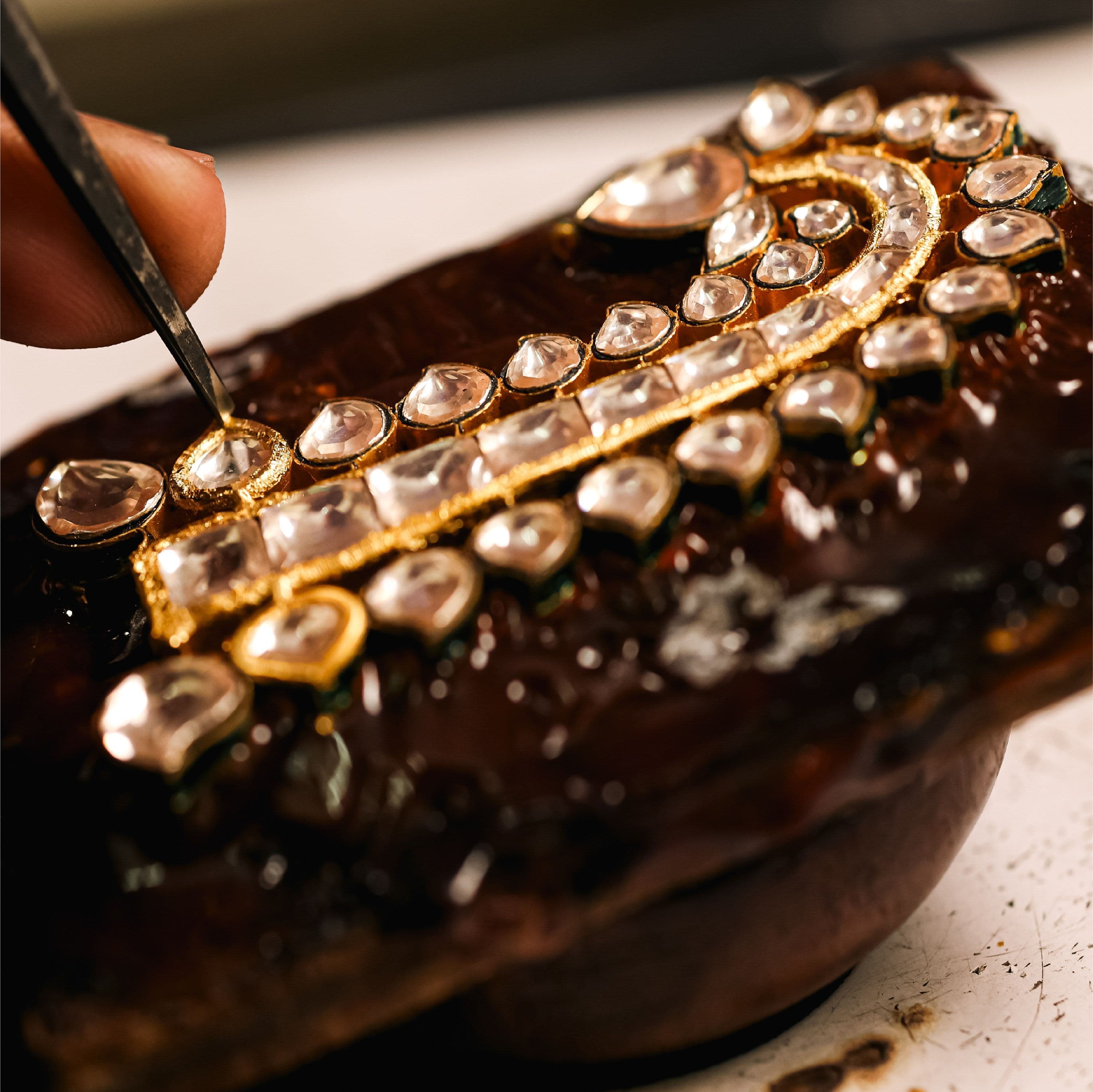
Gem setting
An uncut diamond, the polki, is set into the surface using kundan. The kundan is a thin slice of twenty-four-karat gold, pressed tightly around each stone to hold it in place — no prongs, only pressure. Artisans work the foil with fine implements of wood and bone. The skill is in the pressure and the angle. A well-set polki sits flat with the surrounding gold, framed by a hairline of kundan that catches the light.
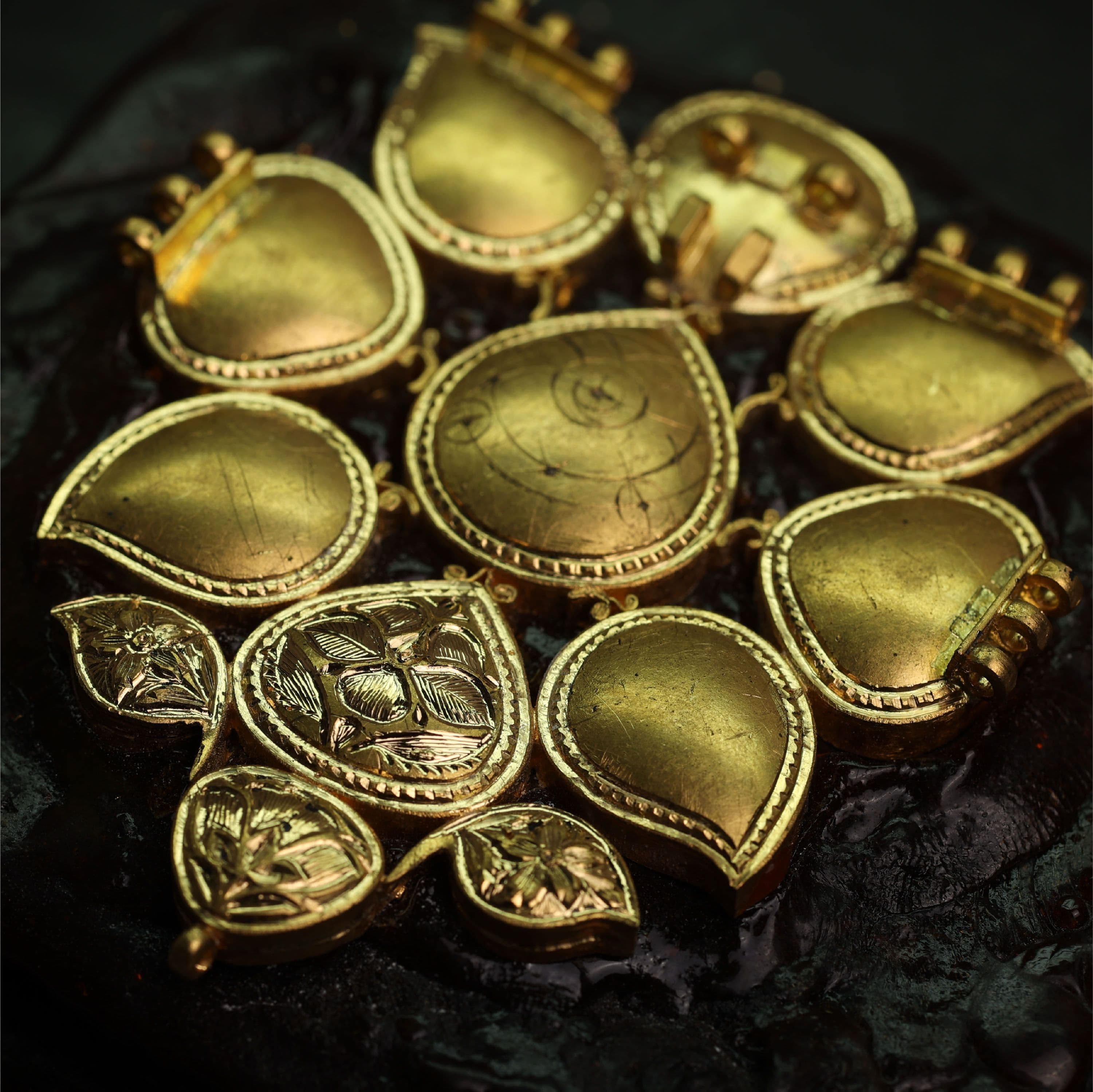
Engraving
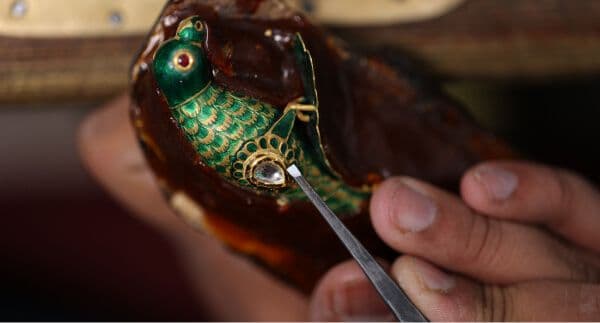
The reverse of the jewel, and any surface not held by a stone, is engraved by a gharaiwala. He works with a burin, a hand tool no wider than a thread, and inscribes the design into the gold as a network of fine cavities. Each cavity will hold one colour.
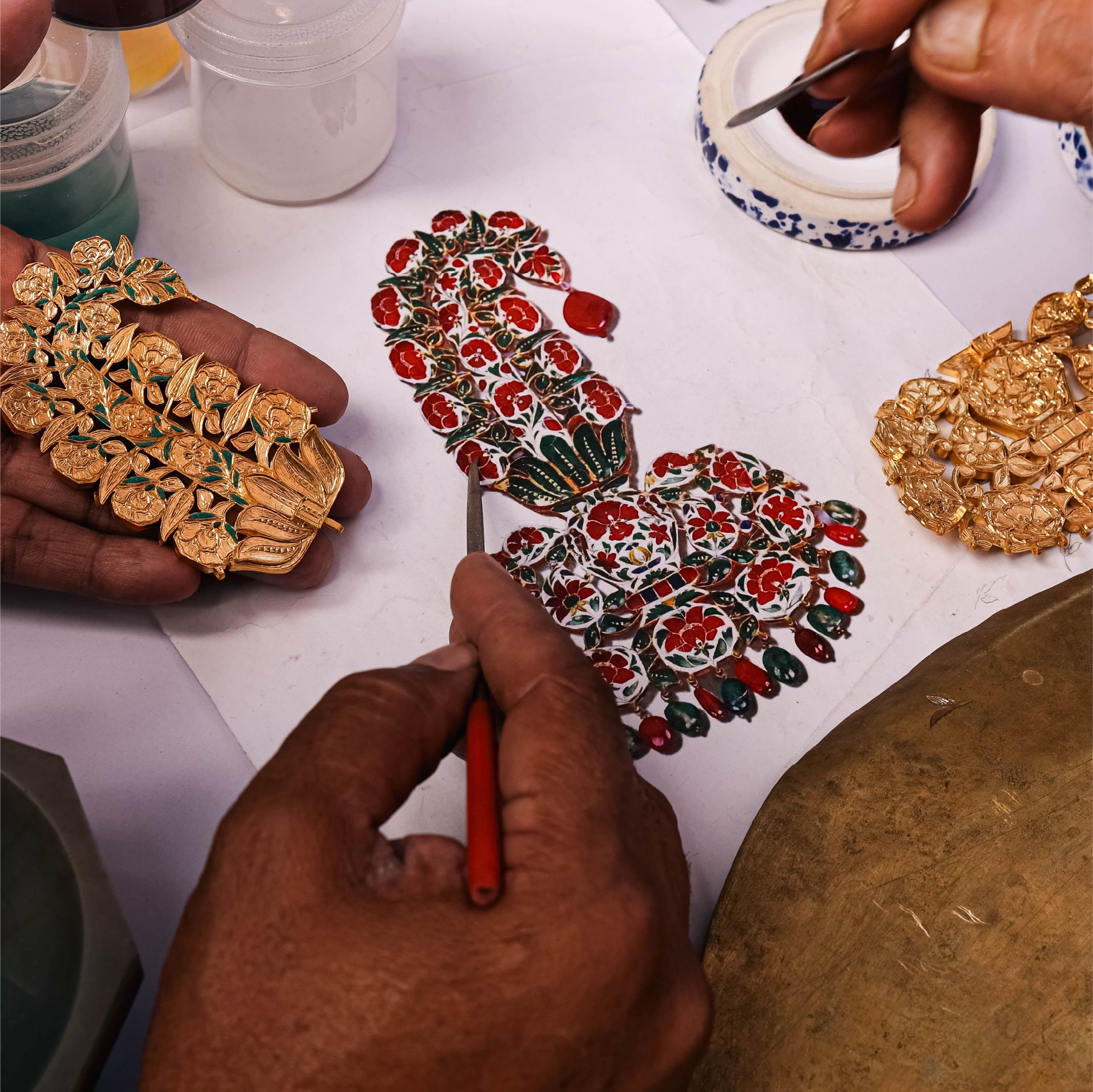
Enamel application
The meenakar grinds the mineral oxides, cobalt for blue, iron oxide for red, copper compounds for green, antimony for white, selenium and gold-chloride for the pink, into a powder. He mixes each with a binder and settles each colour into its cell with a fine brush. Only one colour at a time.
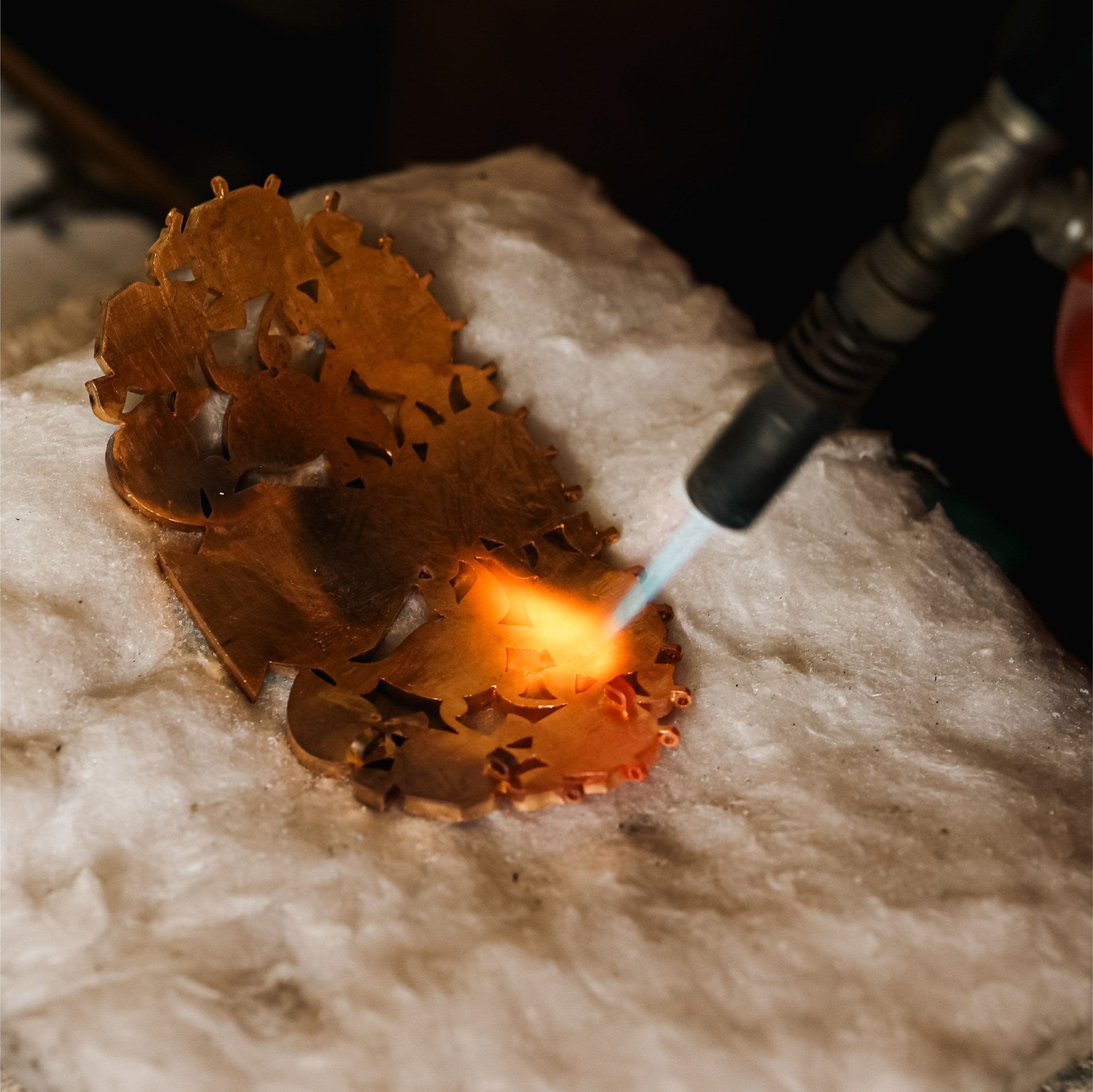
Firing
The jewel enters the kiln. Each colour is fired at its own temperature, between seven hundred and fifty and eight hundred and fifty degrees Celsius. A piece carrying three colours is fired three times. A piece carrying seven colours is fired seven times. Between firings, the piece is cooled, cleaned, and the next colour is laid in.
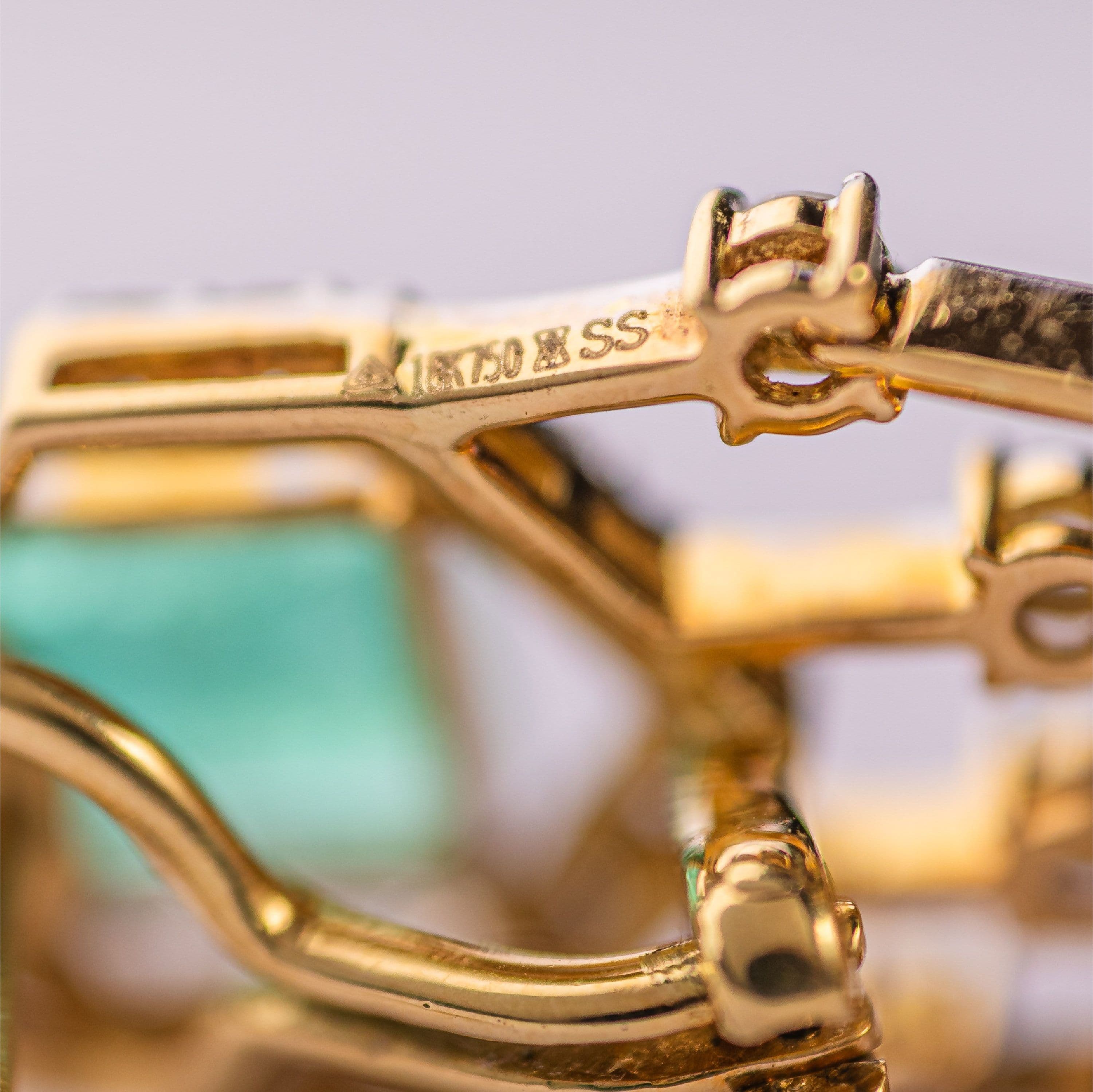
Polishing
After the final firing, the surface is polished by hand against soft leather wheels and pastes graded from coarse to fine, until the enamel sits flush with the gold and reflects the light without distortion.
Meenakari vs French enamel: the difference
Two traditions. One bench.
Meenakari and French enamel differ in where the colour sits and how it holds light. In meenakari, opaque enamel is settled into cells engraved in gold and fired, giving dense, jewel-bright colour that is often worked on the reverse of a piece as richly as the front. French enamelling favours translucency: plique-à-jour holds enamel in an open framework like stained glass, champlevé fills carved recesses, and basse-taille lets light play over a patterned metal surface beneath a transparent layer. The House of Sunita Shekhawat practises both traditions under one roof, a combination not found elsewhere in India.
Indian enamel, which we know as meenakari, is a distant cousin of the Limoges tradition. The two share a mediaeval European origin, a chemistry of mineral oxide fused into silicate glass, and a patience known to almost no other craft. They diverge in the colour, in the metal beneath, and in the tool that makes the first cut. Meenakari is laid in the engraved cells of a twenty-two-karat gold surface. It is opaque, jewel-toned, and read primarily from the front. The French enamel tradition runs through several techniques, each with its own grammar.
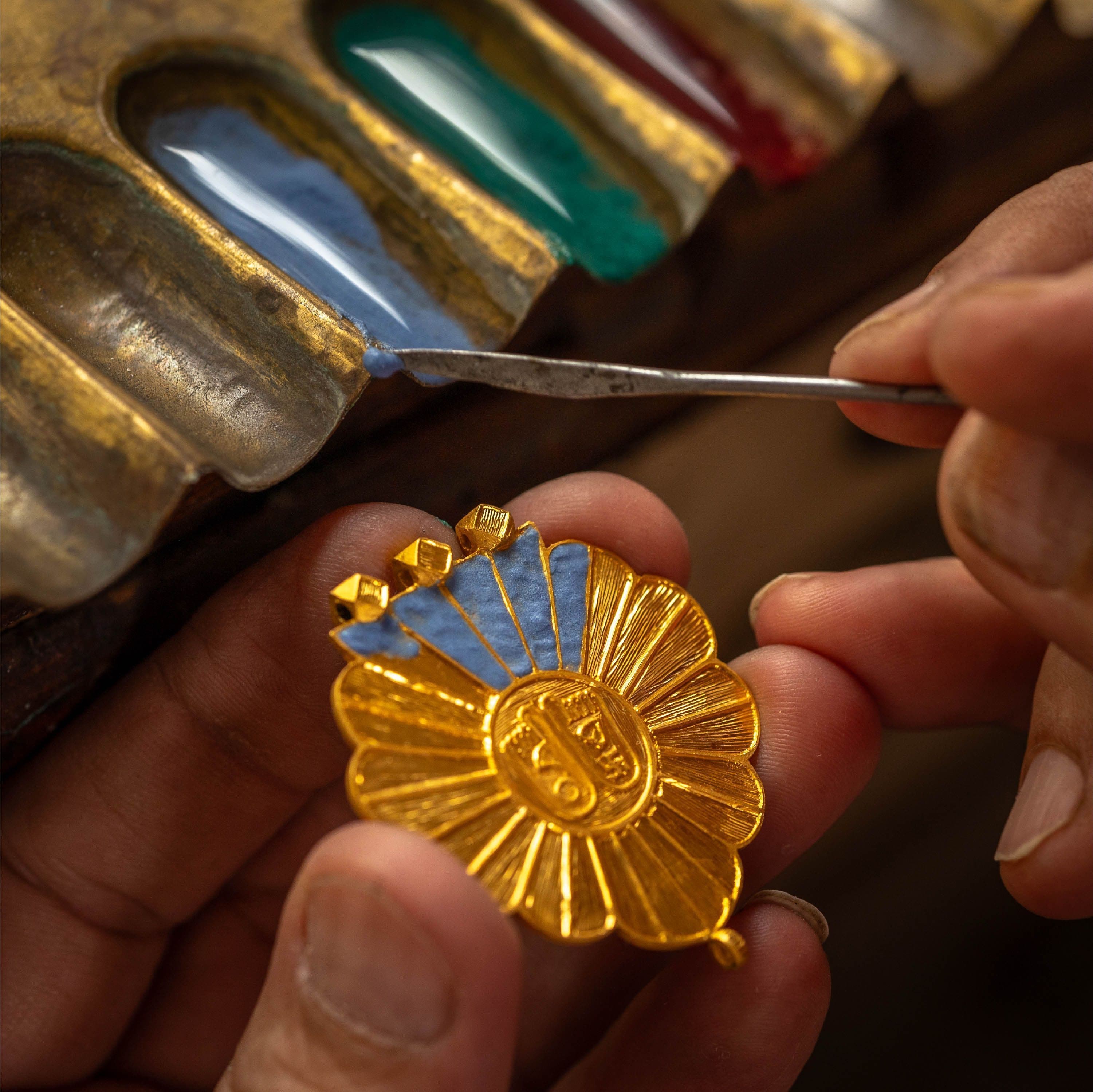
Champlevé : enamel laid into engraved cells, much like meenakari, but on silver or copper rather than gold, and historically in a different palette
Plique-à-jour : enamel held in an open framework with no metal backing, so light passes through the colour as it does through stained glass
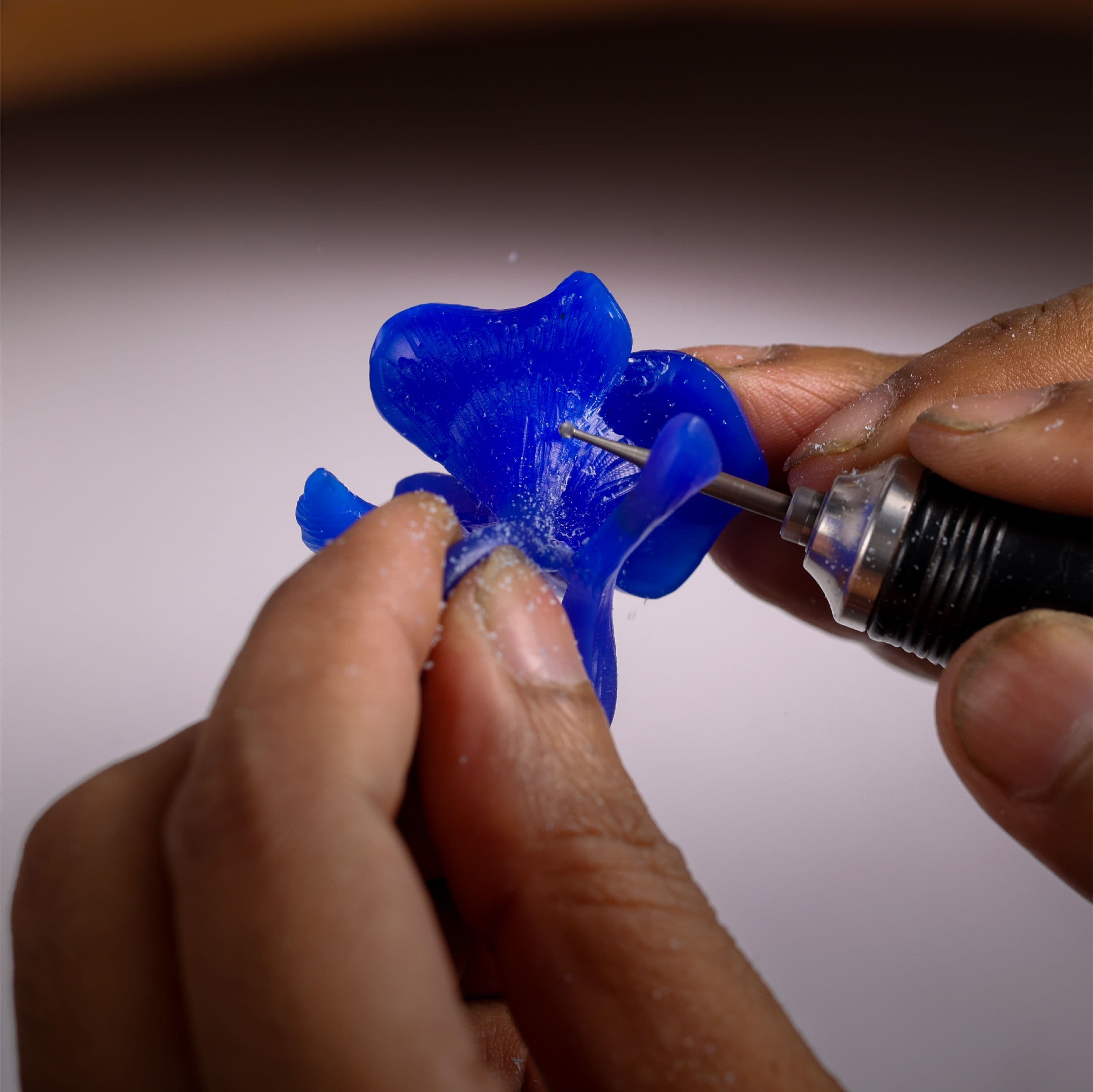
Basse-taille : transparent enamel laid over a low-relief engraved base, so the engraved pattern is visible beneath the colour
Cloisonné : enamel laid between fine metal wires fused to the base, the wires drawing the pattern's outline
The two traditions hold light differently. Meenakari turns the light inward: the gold beneath the cell sends a deep, contained glow back through the colour. French enamel, in its plique-à-jour mode, passes light through. A meenakari pendant glows like a stained-glass window seen by candlelight from inside a chapel. A plique-à-jour earring is the chapel window seen from outside, by day.
At The House of Sunita Shekhawat, the two traditions now meet on the same bench. The atelier's French enamel is a quiet revival of a European craft, carried out with the same patience India has given the work since the sixteenth century. It is the only luxury house in India practising both Indian meenakari and French enamel at the bench.

How to Identify Authenticity
Authentic meenakari rewards slow looking. A real piece carries the marks of its own making, and most of them are plain to the naked eye. Six signs distinguish fine work from the surface imitations the market has lately crowded with.
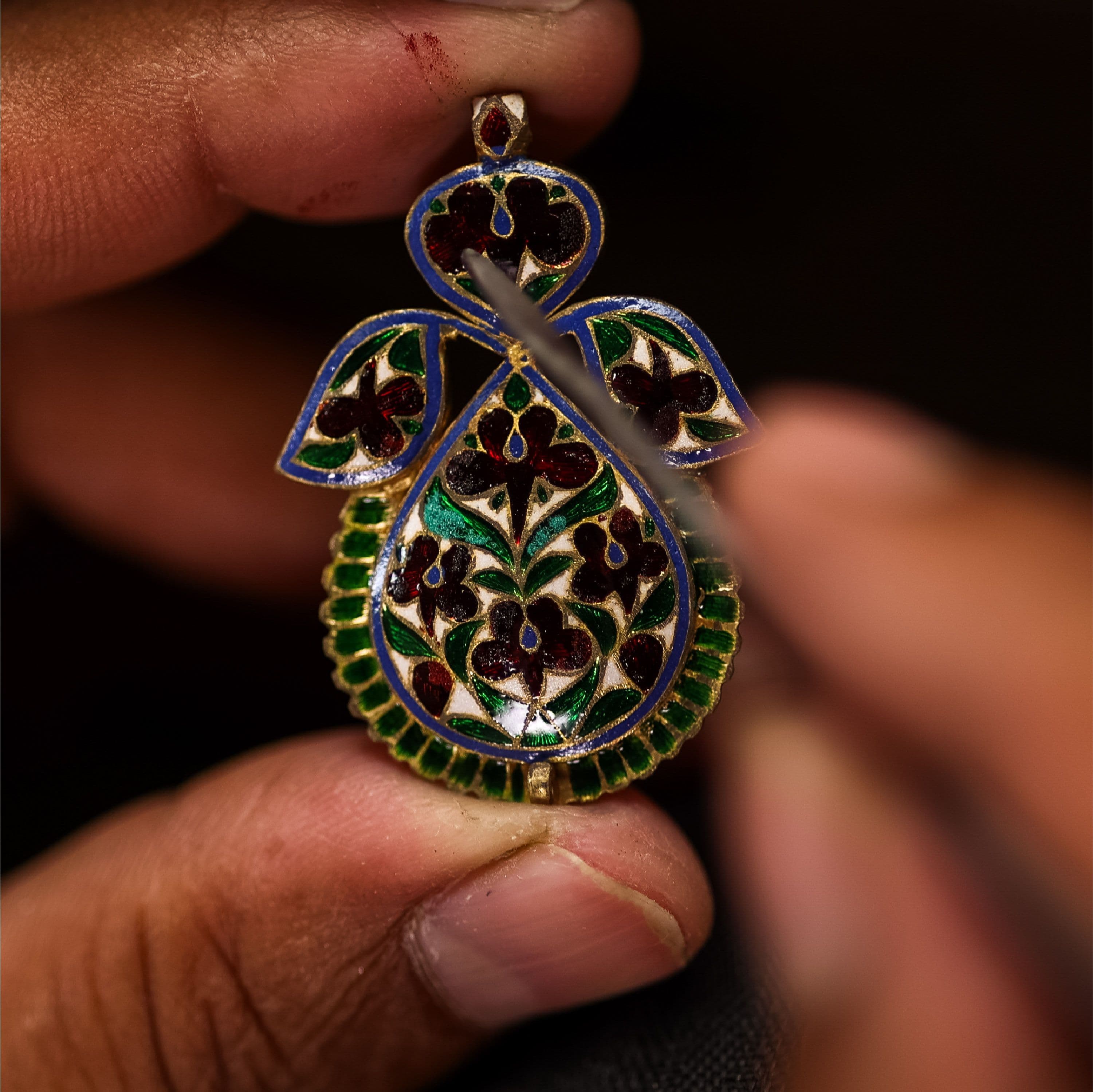
Reverse enamelling
A real meenakari jewel is enamelled on both faces. The reverse is not blank. It carries a smaller design, often in a single colour or a contrasting palette, signed in some workshops by a small painted bird, the tota or parrot, or a floral motif. A piece beautiful only from the front is considered incomplete.
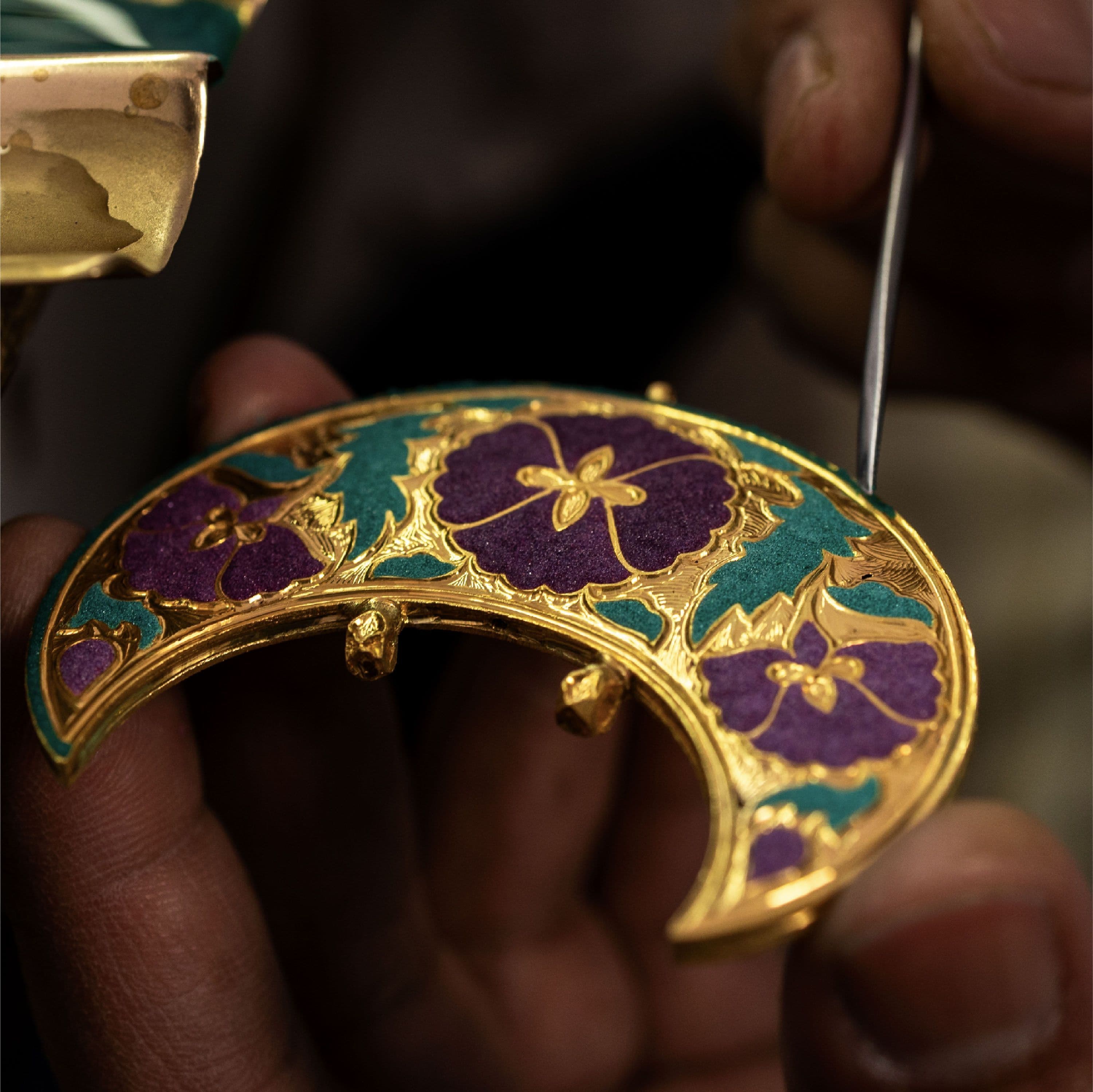
Cell consistency
The engraver's hand leaves a signature. Each cell of a single colour should match its neighbours in depth and edge. Inconsistency reads as machine work or hurried craft.
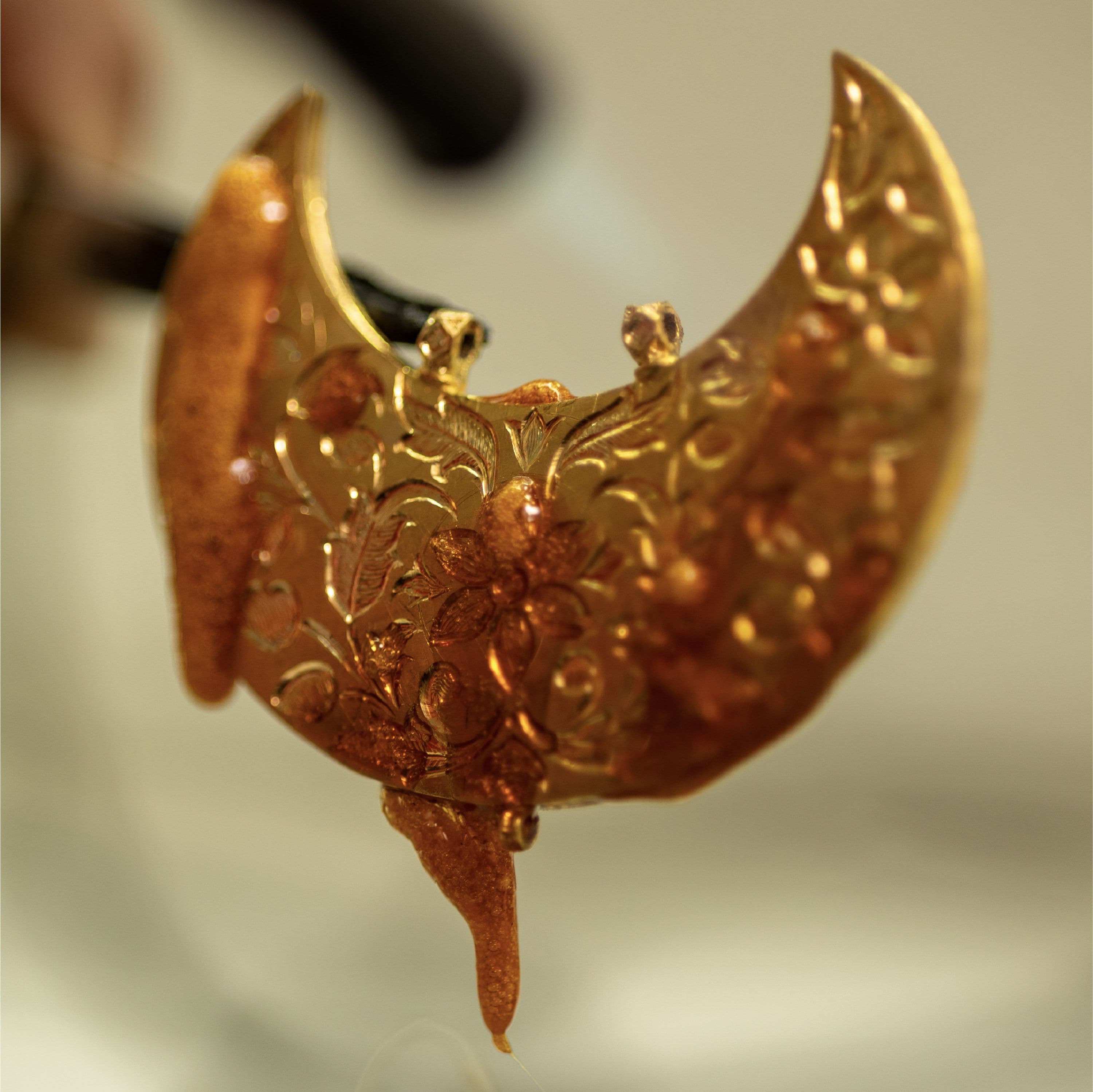
Colour depth from multi-firing
Real meenakari has been fired once for each colour. The depth of a fired colour is impossible to fake with paint, lacquer, or single-bake imitations. Held against light, a real enamel glows. An imitation looks matte and flat.
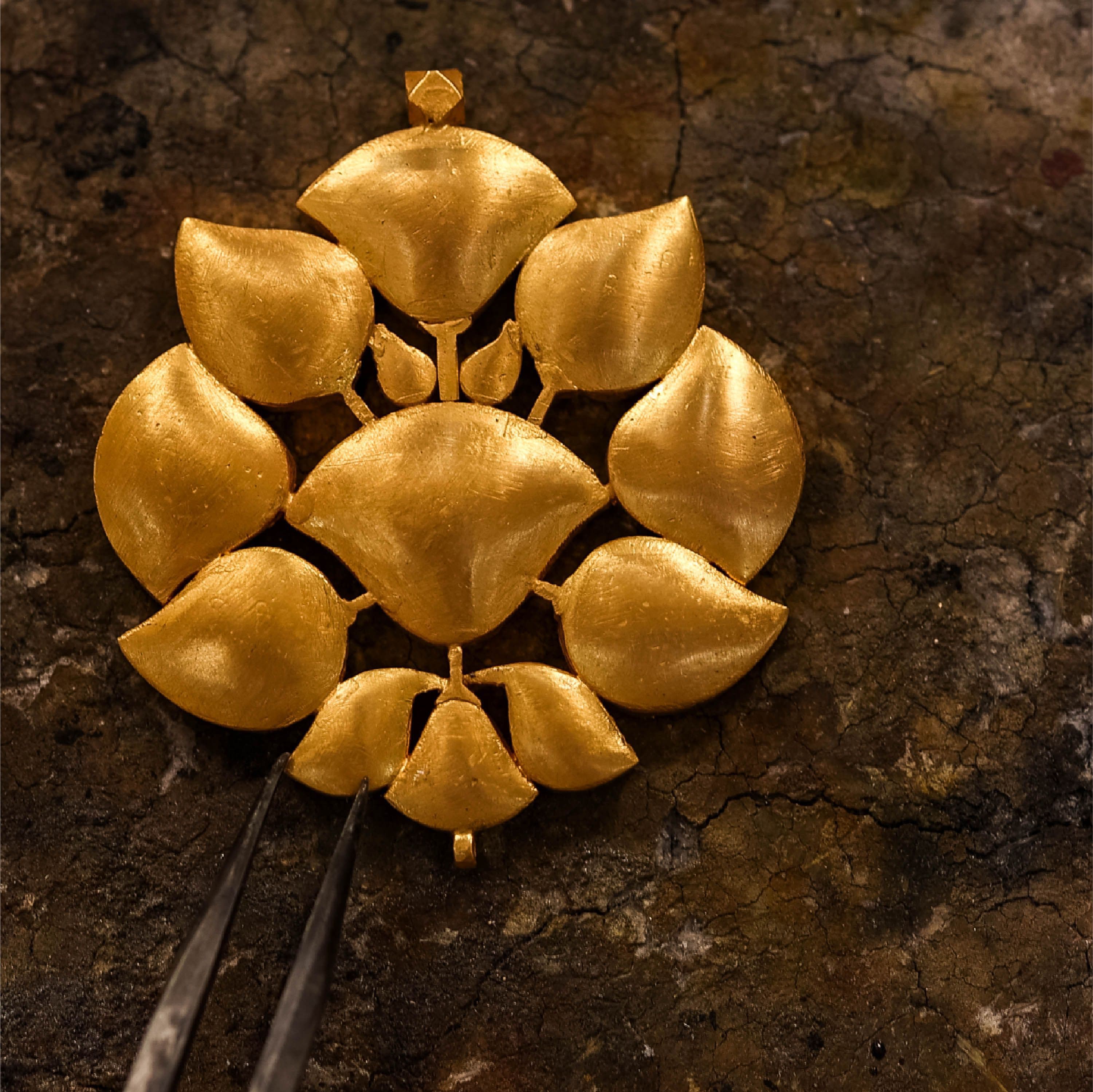
The base metal
Real meenakari is laid on twenty-two-karat gold. The weight, the colour of the gold visible at the cell edges, and the softness against the hand all differ from imitations on brass, silver-plate, or low-karat alloy. Gold also holds enamel as no other metal can: it is inert at the kiln's heat, so the colour stays true for generations, where silver reacts and clouds the enamel from beneath over time.
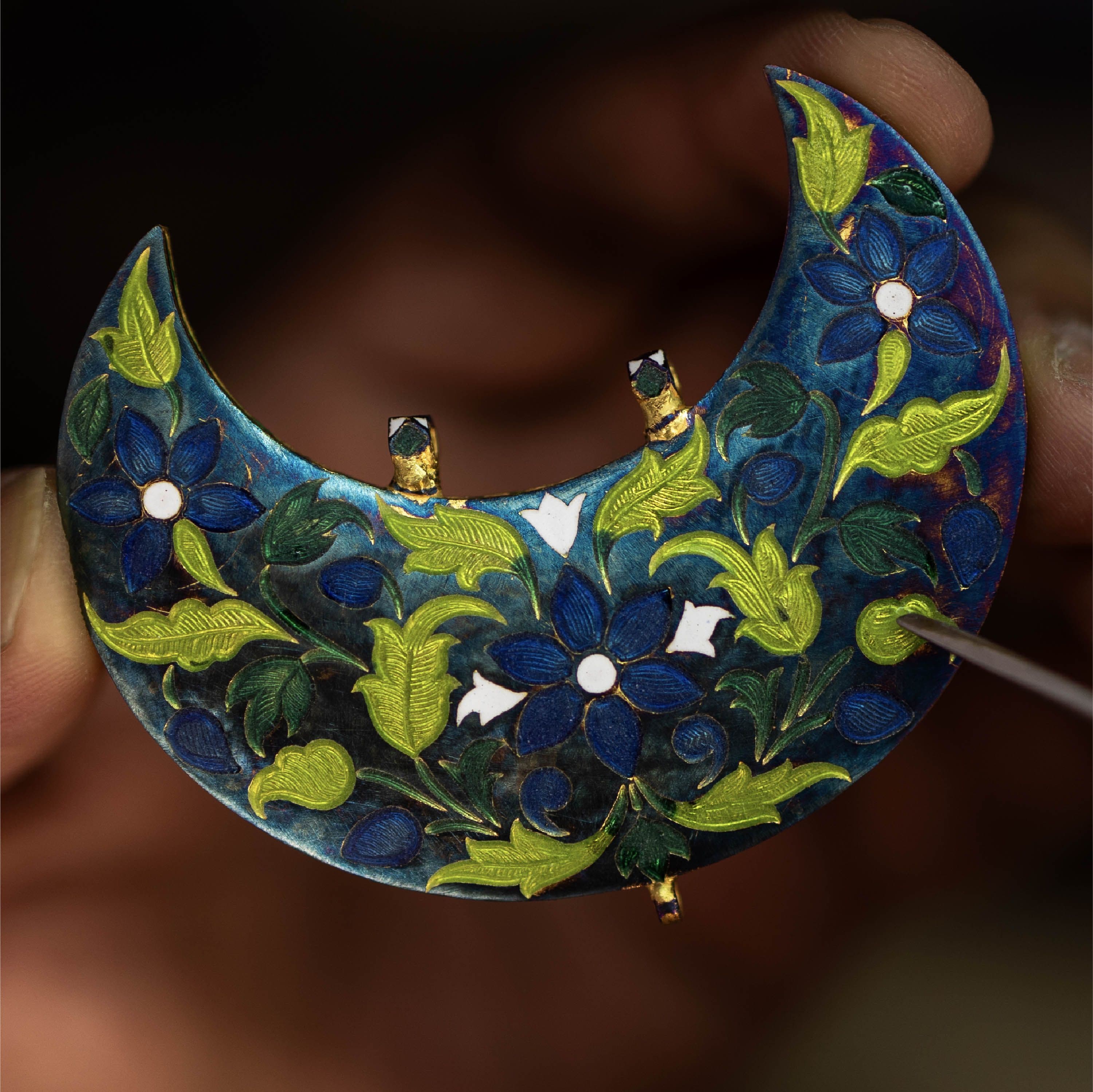
Glass-to-glass transitions under a loupe
Under tenfold magnification, the boundary between two adjacent colours is a fused glass-to-glass edge, not a painted line. The fusion is the proof.
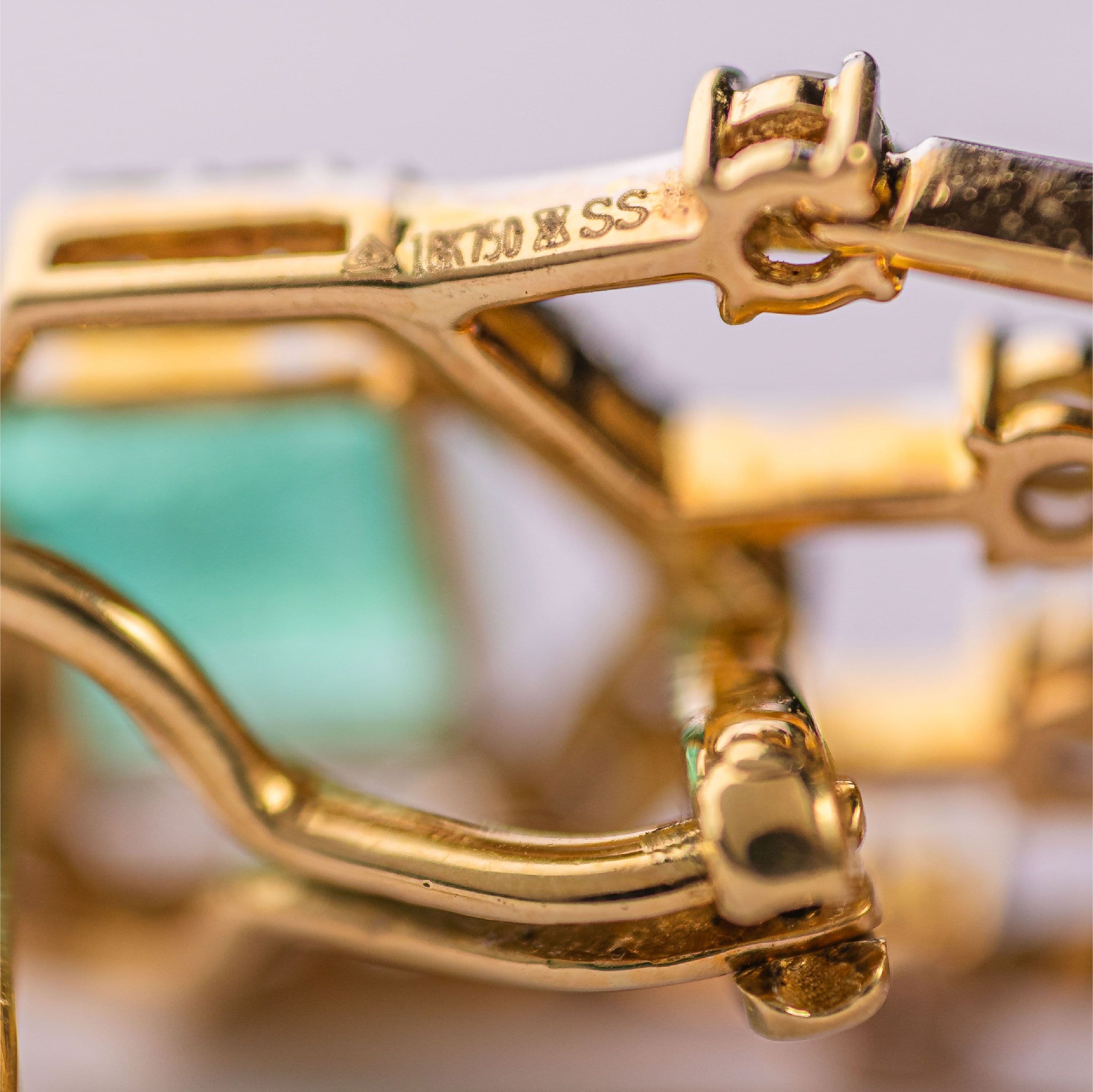
Provenance
Every piece from The House of Sunita Shekhawat leaves the atelier with a certificate of authenticity. Provenance can be followed for as long as the piece is kept.
A meenakari jewel, in the end, is a record of its own making. The marks do not lie.
Caring for Meenakari
Meenakari enamel is fused glass on metal. Fired correctly, it is remarkably durable. A well-made piece passes from one generation to the next without losing its colour. Thoughtful handling is all that the craft asks.
Keep each piece in its own soft-lined box. Enamel against enamel, or enamel against a harder stone, can scratch with time. A partitioned tray, lined in felt or velvet, works well and keeps related pieces together. Avoid storing meenakari with metal-on-metal contact.
Wipe the surface gently with a soft, lint-free cloth after each wear. Avoid soaking meenakari in water. Keep it away from perfume, hairspray, cosmetics, and household chemicals, especially bleach, which dulls the finish over time. Remove the piece before bathing, before swimming, and before stepping into a chlorinated pool.
The atelier's full guide on meenakari, polki, and diamond care is on the Care Advice page. The atelier has held the craft since 1996. Questions on a specific piece can be raised through the Contact page.
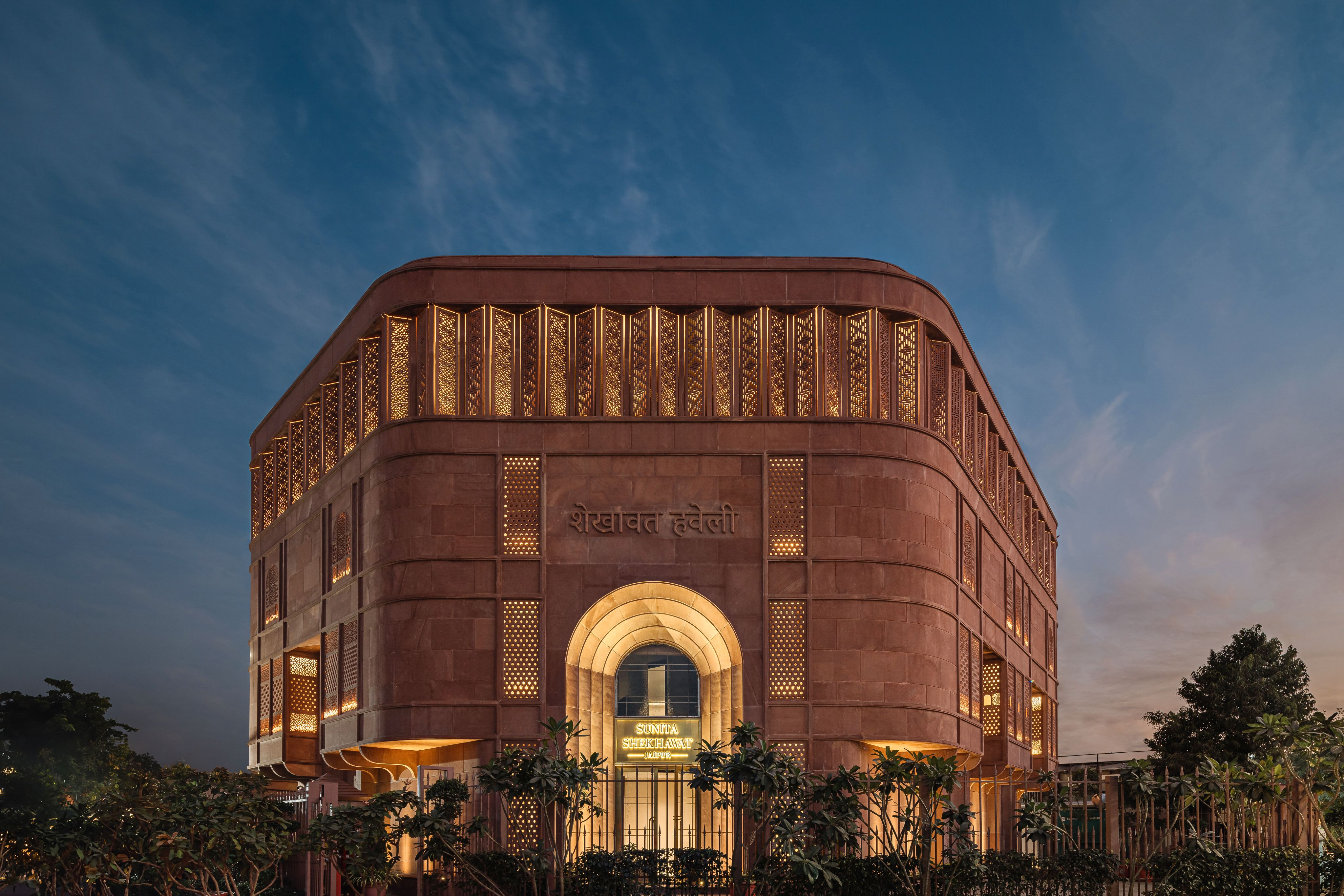
The Museum of Meenakari Heritage
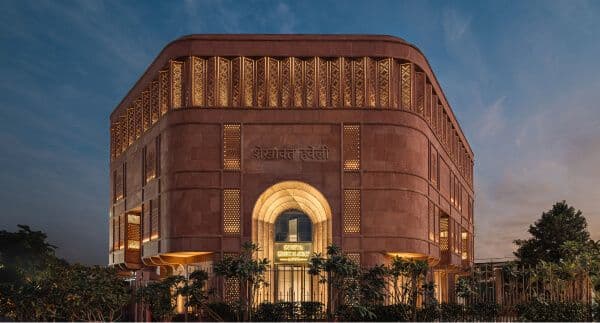
The Museum of Meenakari Heritage is a long-nurtured dream of Sunita Shekhawat made into a room. It spans three thousand square feet, sits near Jaipur's historic walled city, and carries the full arc of enamel's journey from mediaeval Europe to the benches of the old city. Sixty original pieces by the founder share the galleries with one hundred and twenty reproductions commissioned by the house, set against more than three hundred images drawn from over fifteen institutions, among them the British Museum, the Victoria and Albert Museum, the Metropolitan Museum of Art, the Art Institute of Chicago, the Al Thani Collection, and the Aga Khan Museum.
A permanent collection, a working atelier, a reference library. Curated by the art historian Dr Usha Balakrishnan, designed by Siddhartha Das Studio. Visits arranged by private appointment.
To walk through the museum is to watch enamel travel in time. From Limoges to Lisbon to Goa, from the Mughal courts to Amer to Jaipur, and from the old city to the drawings on the desk today.
Today, meenakari is practised across India. Jaipur remains its hub. The House of Sunita Shekhawat is most celebrated for the pink, the Gulabi tradition this house has carried forward at the bench. The journey is not finished. It continues, one firing at a time.

Frequently Asked Questions
People also ask.
Meenakari is the Indian art of enamelling. Powdered mineral glass is settled into engraved cells on a gold surface and fired in a kiln until the glass fuses with the metal. The result is a coloured jewel surface that holds its hue for generations. At The House of Sunita Shekhawat, meenakari is laid on a twenty-two-karat gold base.
The word is Persian. Meena means enamel, and before that, the azure sky. Kari is the act of placing. To make meenakari is to place colour, drawn from sky and earth, onto gold.
Rajasthan is the state most famous for meenakari, and within Rajasthan the city of Jaipur is its hub. Other Indian centres include Varanasi in Uttar Pradesh (for the pink, Gulabi), Lucknow, Hyderabad, and Pratapgarh.
Jaipur. The craft was carried into the city under Mughal-era patronage in the late sixteenth century, and Jaipur has been India's leading centre of enamel jewellery since the eighteenth century.
A meenakari jewel is the work of seven or eight specialist karigars, each carrying out a single stage. Each colour requires its own firing. A small pendant takes several weeks. A multi-colour bridal piece can take months. The price reflects the time, the skill, and the gold beneath the enamel.
It means enamel laid on a gold base, usually twenty-two-karat. The gold is engraved into fine cells; mineral powders are settled in; the piece is fired once for each colour it carries. Gold is inert at firing temperature, which is why a meenakari surface on gold holds its colour without tarnish over generations.